Dec. 28 liturgy at cathedral to close Jubilee year; local Church members travelled to Rome as ‘Pilgrims of Hope’
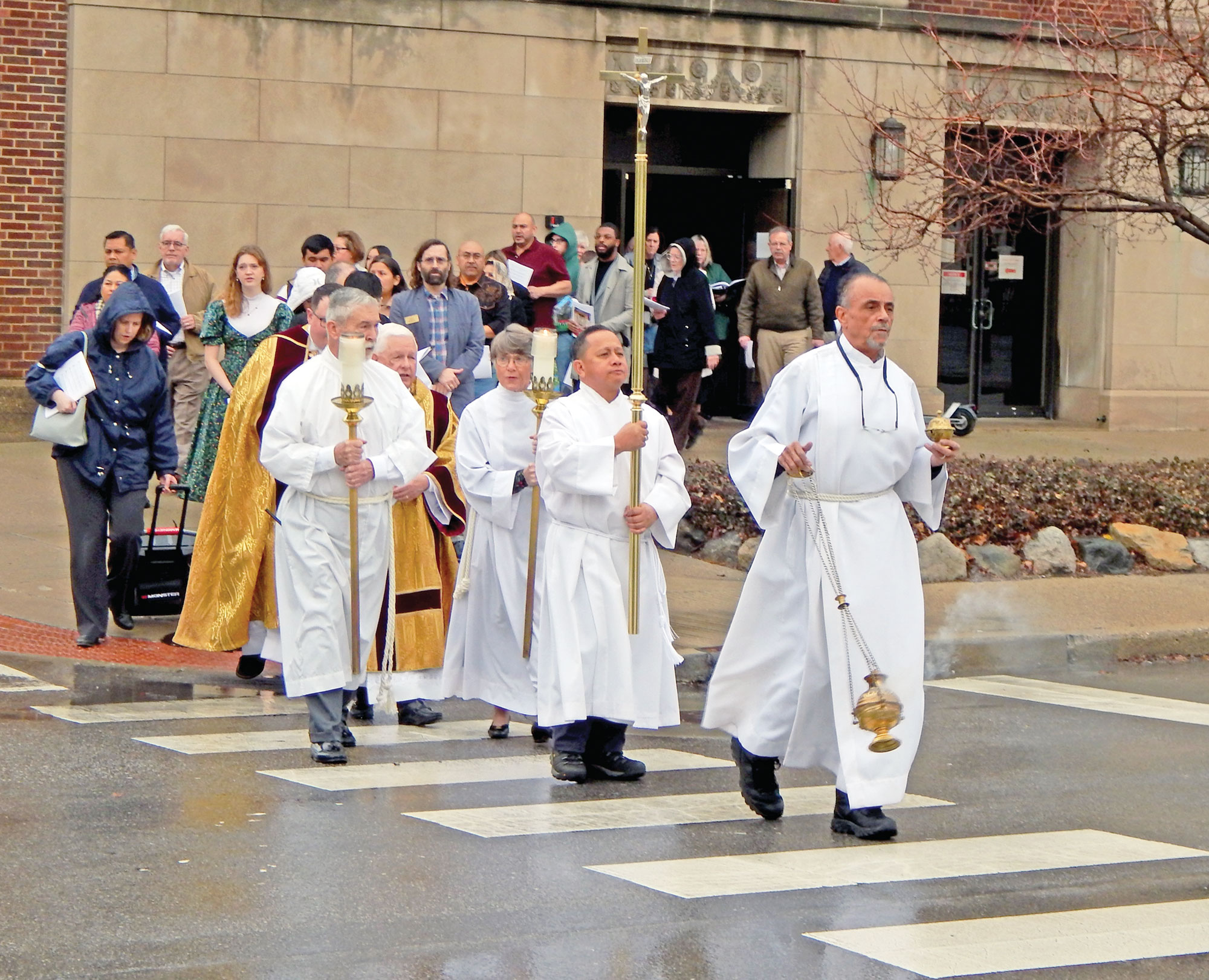
People process across Meridian Street from the Archbishop Edward T. O’Meara Catholic Center to SS. Peter and Paul Cathedral on Dec. 29, 2024, after a prayer service to mark the start of the 2025 Jubilee Year, whose theme is “Pilgrims of Hope.” (File photo by Mike Krokos)
Criterion staff report
It began in the archdiocese on Dec. 29, 2024, with a prayer service at the Archbishop Edward T. O’Meara Catholic Center, followed by a procession across the street for Mass at SS. Peter and Paul Cathedral, both in Indianapolis.
Father James Brockmeier, rector of the cathedral, opened the 2025 “Pilgrims of Hope” Jubilee year.
While the holy doors of the four major basilicas of Rome close at the end of the Jubilee on Jan. 6, 2026, the local celebration of the Jubilee year will come to a close during a 10 a.m. Mass on Sunday, Dec. 28, at the cathedral. All are invited to attend.
‘Our cross of hope’
During the prayer service last December, Father Brockmeier explained the significance of the cross chosen for the event—the cross that soon thereafter led the procession to the cathedral, where Father Brockmeier celebrated a Mass marking the feast of the Holy Family of Jesus, Mary and Joseph.
“It is the cross that led the eucharistic procession through the streets of Indianapolis [during the National Eucharistic Congress],” he explained of the cross that resided in the cathedral during the jubilee year announced by Pope Francis in May of 2024. “That is why it is our cross of hope, reminding us to be pilgrims of hope, reminding us to be people who bring our Lord in the Eucharist out into the world.”
‘Jesus, the door of salvation open for all’
On Christmas Eve, 2024, Pope Francis opened the holy door of Jubilee 2025 in St. Peter’s Basilica. This door represents “Jesus, the door of salvation open for all,” the pope said in his message “urbi et orbi” (to the city and the world):
“Jesus is the Door; the Door that the Father of mercies has opened in the midst of our world, in the midst of history, so that all of us can return to him,” Pope Francis said. “We are all like lost sheep; we need a Shepherd and a Door to return to the house of the Father. Jesus is that Shepherd; Jesus is the Door.”
“For everyone,” the Holy Father said in his papal bull announcing this special year, “may the jubilee be a moment of genuine, personal encounter with the Lord Jesus, the ‘door’ [Jn 10:7-9] of our salvation, whom the Church is charged to proclaim always, everywhere and to all as our hope” (1 Tm 1:1).
The history of jubilees in the Church
A jubilee or holy year is a special year in the life of the Church ordinarily celebrated every 25 years.
Jubilee years have been held on regular intervals in the Catholic Church since 1300, but they trace their roots to the Jewish tradition of marking a jubilee year every 50 years.
According to the Vatican website for the jubilee, these years in Jewish history were “intended to be marked as a time to re-establish a proper relationship with God, with one another and with all of creation, and involved the forgiveness of debts, the return of misappropriated land and a fallow period for the fields.”
A variety of talks, retreats and similar events touched on the theme “Pilgrims of Hope” throughout the archdiocese, but local pilgrims also journeyed to Rome.
A digital missionary and Catholic influencer
Twenty-four-year old Sophia Chamblee in late July took part in the Vatican’s Jubilee of Digital Missionaries and Catholic Influencers—a gathering that drew more than 1,000 people from more than 70 countries to Rome.
A member of St. Joan of Arc Parish in Indianapolis, Chamblee graduated from college in 2023 and shortly thereafter created the website,
www.playgroundsaints.shop, where she sells stickers, prints and keychains featuring the saints. She also shares her focus on saints on the social media platform Instagram @playgroundsaints. She posts stories and self-described “goofy” videos about the saints, hoping to show their humanity.
She was also in Rome on Sept. 7 for the canonization Mass honoring the saint who changed her life—St. Carlo Acutis.
“I first heard about Carlo Acutis during COVID,” Chamblee said. “That was when he was beatified. He really stood out to me because he was a nerd. And I am also a huge nerd. I was a huge Star Wars fan growing up, and that’s drifted off into other things. I really saw myself in Carlo.”
The more she learned about him, the more she was impressed—and felt a bond with him.
“He wanted to use the Internet to evangelize. And that’s what I wanted to do as well,” she said. “Maybe not in the same way as him. He built a website documenting eucharistic miracles. That way people had all the information they needed in one place.
“I saw myself in Carlo as having that dream of using the Internet as a tool to evangelize. I’ve used the Internet to learn how to draw, how to film, how to use different apps. I wanted to use it to talk about Catholic saints. So, he kind of became the patron saint of my mission.”
‘What it means to be a pilgrim of hope’
In the fall, as the chairman of the Committee on Evangelization and Catechesis of the U.S. Conference of Catholic Bishops (USCCB), Archbishop Charles C. Thompson led a group of 30 pilgrims to Rome for the Jubilee of Catechists. The trip was sponsored by the USCCB.
Archbishop Thompson gave a presentation to English-speaking catechists from around the world in Rome on how catechists are doors of hope. He prayed at the tomb of Pope Francis at the Basilica of St. Mary Major in Rome. And he and the pilgrimage group met Antonia Salzano, the mother of St. Carlo Acutis in Assisi.
During the trip, the group had a private audience with Pope Leo XIV, which was a highlight for pilgrims.
Archbishop Thompson also met one-on-one with the Holy Father, where the pope asked about the Church in Indiana.
“We do so many wonderful things here,” the archbishop said. “I shared that we have a very vibrant Church here in central and southern Indiana. We talked about how our people are so very good at doing national events, mentioning the Eucharistic Congress.”
Archbishop Thompson noted that coming to Rome specifically for the Jubilee for Catechists “kind of heightened the notion of what it means to be a pilgrim of hope.”
“Every baptized person is called to be sent out,” he said. “We each have our own unique way—lay or ordained—to carry that out. But we all have that same common baptismal call to holiness and mission and to proclaim through witness and action the good news. How do we draw people to Jesus Christ?”
Synodality: A gift to the Church, world
Ken Ogorek, executive director of the archdiocesan Secretariat for Evangelizing Catechesis, visited Rome during the Oct. 24-26 Jubilee of Synodal Teams and Participatory Bodies at the Vatican.
The meetings occurred in the context of a Jubilee Year event in Rome, and as coordinator of the archdiocesan synod implementation team, he participated in a gathering of his counterparts from throughout the world.
The Jubilee included workshops and other gatherings to further strengthen the implementation phase of the final document of the 2021-2024 Synod of Bishops on synodality.
During an Oct. 26 Mass to close the Jubilee of Synodal Teams and Participatory Bodies, Pope Leo told the approximately 2,000 people gathered that the supreme rule in the Catholic Church is love, which compels all of the faithful to serve, not to judge, exclude or dominate others.
“No one should impose his or her own ideas; we must all listen to one another. No one is excluded; we are all called to participate,” he said in his homily. “No one possesses the whole truth; we must all humbly seek it and seek it together.”
Ogorek said the pope’s message spoke to the common vocation of all the faithful to be missionary disciples.
“Among the thoughts that Pope Leo shared is that synodality is about having a strong sense of mission, acknowledging that Christ has commissioned each baptized person to be his missionary, witnessing to him to the ends of the Earth,” Ogorek wrote in a column for The Criterion.
“Synodality’s focus on mission affirms our archdiocesan pastoral planning process, whose theme is ‘Go Forth in Joy and Hope as Missionary Disciples,’” Ogorek noted. †