Jews and Catholics come together to mark 60 years of dialogue
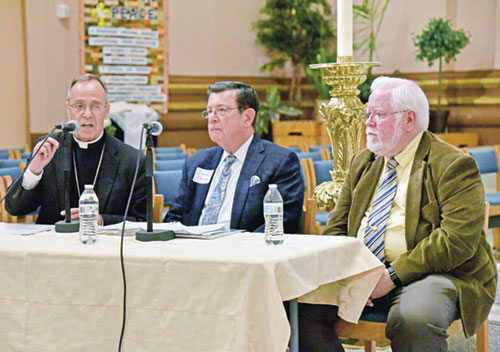
Archbishop Charles C. Thompson, left, speaks on Nov. 16 at SS. Peter and Paul Cathedral in Indianapolis during a Catholic-Jewish dialogue with Rabbi Dennis Sasso, center, rabbi emeritus of Congregation Beth-El Zedeck in Indianapolis, and Philip Cunningham, theology professor at St. Joseph’s University in Philadelphia and director of its Institute for Catholic-Jewish Relations. (Photo by Sean Gallagher)
By Sean Gallagher
On Nov. 16, Catholics and Jews from across Indianapolis gathered for a dialogue at SS. Peter and Paul Cathedral in Indianapolis.
The event was a celebration of the 60th anniversary of the vote at the Second Vatican Council to approve “Nostra Aetate” (“In Our Age”), its “Declaration on the Relation of the Church to Non-Christian Religions.” It was co-sponsored by the archdiocese and the Jewish Community Relations Council in Indianapolis.
According to the keynote speaker at the event, the dialogue was a fruit of that declaration and would have been unthinkable before it.
Philip Cunningham, a professor of theology at Saint Joseph’s University in Philadelphia and director of its Institute for Catholic-Jewish Relations, gave the keynote address at the event.
He later participated in a conversation with Archbishop Charles C. Thompson and Rabbi Dennis Sasso, rabbi emeritus of Congregation Beth-El Zedeck in Indianapolis, a longtime leader in Indianapolis’ Jewish community.
‘We’ve never walked away from each other’
In his keynote address, Cunningham noted how, when the bishops at Vatican II
approved “Nostra Aetate,” Jews and Catholics “didn’t know how to talk theologically to one another. We hadn’t done it for 18 centuries, plus or minus.
“Today, thank goodness because of ‘Nostra Aetate,’ there are structures, relationships and friendships that are able to address the inevitable disagreements and conflicts and maybe even crises that turn up,” he added. “We’ve never walked away from each other, and we haven’t today either.”
He explained how St. John Paul II, Pope Benedict XVI and Pope Francis all made major contributions to explaining the Church’s understanding of the relationship of the Jewish faith and people to Christianity.
This included the recognition by St. John Paul that the Jewish people are “in a permanent covenantal relationship with God.”
“This is huge, huge, huge,” Cunningham said. “I can’t overstate it.”
St. John Paul, Cunningham continued, also set “certain parameters” for Catholic-Jewish dialogue for members of the Church, noting that proselytization was out of the question.
Pope Benedict added to his predecessor’s teaching by encouraging Jews and Catholics to discern together the meaning of the will of God and the word of God.
“That’s really quite phenomenal,” Cunningham said. “If we don’t dialogue together, is there a possibility we’re not understanding God’s will and word aright? Are we missing something without that dialogical activity informing our reading of the scriptural text?”
Finally, Cunningham said that Pope Francis, in his 2013 apostolic exhortation “Evangelii Gaudium” (“The Joy of the Gospel”) noted that, “ ‘God continues to work among the people of the old covenant and to bring forth treasures of wisdom which flow from their encounter with his word’ ” (#249).
“We’ve come a long way since 1965,” said Cunningham. “A lot has happened in the last six decades. There have been moments … where there has been controversy and conflict and disappointment and hurt. But that has not stopped the ongoing grappling with all of the implications of ‘Nostra Aetate.’ And that still continues.”
Reflections on Oct. 7, 2023
In the past two years, a good part of that “grappling” has been related to Catholics and Jews both coming to terms with the meaning and ongoing effects of the attack of Hamas on Israel on Oct. 7, 2023.
Cunningham made several brief points in his address on the effect the war that occurred in the wake of the Oct. 7 attack has had on Catholic-Jewish relations.
In one of them, he reflected on the growth of various forms of hatred in society in recent years.
“We’re all struggling with the huge growth of anti-Semitism,” Cunningham said. “That cannot be forgotten. We also have to remember we’re also dealing with Islamophobia breaking out in degrees as well, and other forms of racism and hatred. Everything has become so polarized, so sensitized, so trigger-happy. This is part of what we have to cope with.”
Cunningham invited Catholics to consider the continuing large role that the Holocaust, which Jews call the “Shoah,” plays in their self-understanding and their view on the world.
“The Shoah affects Jews differently than Christians,” he said. “Jews are more likely, therefore, to feel that Israel is under an existential threat than Christians generally are. So, we’ve got to remember that when we’re talking about the Middle East.”
During the dialogue portion of the event, Rabbi Sasso spoke about connections of past accusations made against Jewish people to those made today.
“The original charge against Jews at the beginnings of Christianity was that of deicide,” he said. “Jews killed Jesus. That was something that brought a lot of trouble upon the Jewish people in different times and places.
“And whereas it was not the cause of the terrible sorrows of the 20th century [in the Shoah], in significant ways it contributed to an understanding of Jews and Judaism that allowed it … .”
The “current charge” against Jews, Rabbi Sasso said, is “genocide.”
Although he noted that the two-year war between Israel and Hamas was the result of “a very complex geopolitical historical problem that needs to be solved,” Sasso also clearly stated that the charge of genocide against Jews is “a fabricated accusation” much like the accusation of deicide.
The Jewish people today being accused of genocide “is just an extension of that identification of the Jews with the ultimate possible evil. And that’s something we need to think about, talk about, and address in its complexity.”
“ … War is terrible. People die in wars. And we want to put an end to war. The ultimate purpose of our dialogues here is to come up with a platform for world peace. Would that we could.”
‘A blessing to the world’
In his contributions to the dialogue, Archbishop Thompson noted the importance of “dignity and encounter” in fostering peace and unity among the diverse peoples of the world and that the dialogue between Catholics and Jews during the past several decades can be a way to model that for others.
“Encounter leads us to a deeper sense of mission, a deeper sense of hope, a deeper sense of a right relationship,” he said. “In the covenant, we reach to something beyond ourselves, and that is being in right relation, not only with each other but with God.
“... Our relationship with God and our relationship with each other are two sides of the same coin. So, I think in interreligious dialogue, that sense of right relationship [helps us] toward holiness and mission.”
Archbishop Thompson noted the importance for him that he was born in 1961, the year before Vatican II was first convened.
“I’ve only known the Vatican II Church,” he said.
Archbishop Thompson said that, as he learned the faith growing up, he saw that the Church “was always respectful to the Jewish people, understanding our own Catholic roots being connected intimately with the Jewish tradition. Jesus was a Jew, and we can’t fully appreciate our own Catholic identity without that part of who we are.”
This respect for the dignity of people different from himself was also fostered in him by his parents.
“We had Jewish people in our house, and we had African Americans in our house,” Archbishop Thomspon recalled. “They implanted us very early on to respect every human being as created in the image of God. There was no exception to that.”
He also said that Catholics of the archdiocese “could be very proud” of the role that Cardinal Joseph E. Ritter played at Vatican II in advocating for “Nostra Aetate.”
A native of New Albany, he served as bishop of Indianapolis from 1934-44, and then as its first archbishop starting in 1944, before being named archbishop of St. Louis in 1946.
Cunningham echoed Archbishop Thompson’s praise of Cardinal Ritter and went on to note the importance of bishops from the U.S. in general at Vatican II in promoting “Nostra Aetate.”
They did this, he said, because Jews and Catholics in the U.S. have a long history of working together in promoting social reforms, from the labor rights movement beginning in the late
19th century to the Civil Rights Movement of the 1950s and 1960s.
“We have the opportunity to be a blessing to the world,” Cunningham said. “There’s nowhere else in the world where Catholics and Jews work together the way we do.”
In considering how to share the blessing of the fruits of “Nostra Aetate” with the broader society, Rabbi Sasso said that “it’s up to us.”
He sees encouragement in the fledgling leadership of Pope Leo XIV in spreading the fruits of that blessing.
“I think that we have two obligations,” Rabbi Sasso said. “One is to get to better understand, appreciate and respect one another. And out of that understanding comes a greater charge, and that is to help to make our city, our state, our country, our world a kinder place, a more just place.
“I think that in many ways, Pope Leo has begun to develop an agenda that we need to take very seriously.” †